
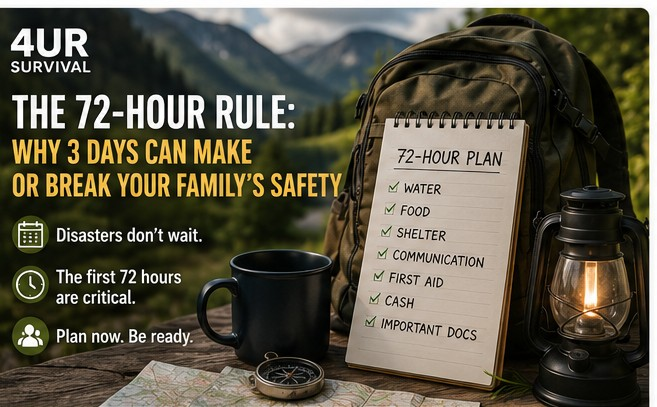
The 72-Hour Rule: Why 3 Days Can Make or Break Your Family’s Safety
You’ve probably heard “be prepared for 72 hours,” but most people don’t fully understand why that number matters.
The Federal Emergency Management Agency explains that in large-scale disasters, emergency services are often overwhelmed within the first 1–3 days.
That means your family becomes your first responder system.
What 72 Hours Really Means
It’s not just survival—it’s stability:
- Food access may be limited
- Roads may be blocked
- Medical help may be delayed
- Stores may be closed or empty
What Most Families Miss
It’s not just supplies—it’s structure:
- Who does what
- Where supplies are located
- How communication works
A Simple 72-Hour Breakdown
Day 1: Stability
- Use stored food
- Assess situation
- Stay informed via radio
Day 2: Adjustment
- Conserve supplies
- Check neighbors if safe
- Maintain routines for kids
Day 3: Sustainment
- Begin rationing if needed
- Prepare for extended disruption
Family Reality Check
If your home lost power, water, and internet for 3 days, would everyone still know what to do?
If not, that’s not a failure—it’s your starting point.
15th Jun 2026
Recent Posts
-
Personal Safety & First Aid: Essential Preparedness for Everyday Life
Why Every Family Should Learn Basic Safety and First Aid Skills Emergencies rarely happen when it's …13th Jul 2026 -

Self-Reliance & Homesteading: Practical Steps You Can Start Today
Building a More Self-Reliant Lifestyle One Step at a Time In a world where prices seem to rise every …6th Jul 2026 -

Why More Families Are Stocking Emergency Supplies in 2026
Over the last few years, many families have started looking at emergency preparedness differently. W …29th Jun 2026